
PhD defense of Carlos González – 18 December 2019

18 December 2019

Thesis defense of Carlos González entitled ‘Multimedia and Multilingual Automatic Summarization and Information Retrieval’ on Wednesday, December 18, 2019, at 2:00 PM in the Thesis Room (Saint Marthe – City Center). Jury: Abstract: As multimedia sources have become massively available online, helping users to understand the large amount of information they generate has become a major issue. One way to approach this is by summarizing multimedia content, thus generating abridged and informative versions of the original sources. This PhD thesis addresses the subject of text and audio-based multimedia summarization in a multilingual context. It has been conducted within the framework of the Access Multilingual Information opinionS (AMIS) CHISTERA-ANR project, whose main objective is to make information easy to understand for everybody. Text-based multimedia summarization uses transcripts to produce summaries that may be presented either as text or in their original format. The transcription of multimedia sources can be done manually or automatically by an Automatic Speech Recognition (ASR) system. The transcripts produced using either method differ from wellformed written language given their source is mostly spoken language. In addition, ASR transcripts lack syntactic information. For example, capital letters and punctuation marks are unavailable, which means sentences are nonexistent. To deal Plus d'infos

End-to-End Spoken Language Understanding on real world tasks

13 December 2019

M.Sc. internship 2020 for 6 months Title End-to-End Spoken Language Understanding on real world tasks Mentored by Mohamed Morchid, Associate Professor Location Avignon University, LIA, France Global Context Project: The internship is strongly related to ANR AISSPER for end-to-end spoken language understanding in different levels of the document content. Web sites: ANR ResearchGate Period: February 2020 to July 2020 Salary: 577.50€ p.m Aims and objectives Neural networks based algorithms are nowadays employed in a massive set of real-world related systems and applications. This internship focuses on Natural Language Processing (NLP) tasks such as Spoken Language Understanding (SLU). Among SLU based models, end-to-end (EtE) neural systems are promising in regard to the results observed already with EtE Automatic Speech Recognition (ASR) with neural based systems. A main drawback of hitherto proposed neural based SLU systems, is related to the need of a two-step process to successively extract high dimensional representation of the relevant content from the spoken signal in a homogeneous feature hidden space (ASR block) alongside to interpret these abstract features as understandable discussed subjects, mentions or intents contained in the spoken dialogue (Natural LU block). Therefore, the errors observed during these two steps are hardly located and characterized, and Plus d'infos

Multiple Partitioning of Multiplex Signed Networks

4 December 2019

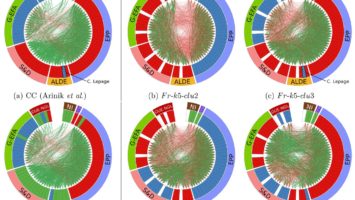
These scripts were designed to analyze the European Parliament votes through a multiplex network-based approach. Our tool was applied to data representing the activity of the members of the European Parliament (MEPs) during the 7th term (from June 2009 to June 2014). The raw data describing this activity were retrieved from the It’s Your Parliament website. There were some minor issues with these data, which we had to correct: some MEPs were represented twice, some profiles were incomplete, the policy domains were not defined for all vote texts, etc. These cleaned data, as well as our figures and results, are available on Zenodo.

PhD defense of Titouan Parcollet – 3 December 2019

3 December 2019

Thesis defense of Titouan Parcollet, entitled “Artificial Neural Networks Based on Quaternion Algebra,” will take place on Tuesday, December 3, 2019, at 2:30 PM in the Blaise Pascal amphitheater (CERI). The thesis will be presented before a jury composed of: The defense will be conducted in French. You are also invited to the reception following the defense in Room 5. Abstract: In recent years, deep learning has become the preferred approach for developing modern artificial intelligence (AI). The significant increase in computing power, along with the ever-growing amount of available data, has made deep neural networks the most efficient solution for solving complex problems. However, accurately representing the multidimensionality of real-world data remains a major challenge for artificial neural architectures. To address this challenge, neural networks based on complex and hypercomplex number algebras have been developed. Thus, the multidimensionality of data is integrated into neurons, which are now complex and hypercomplex components of the model. In particular, quaternion neural networks (QNNs) have been proposed to process three-dimensional and four-dimensional data, based on quaternions representing rotations in our three-dimensional space. Unfortunately, unlike complex-valued neural networks, which are now accepted as an alternative to real-valued neural networks, QNNs suffer from several limitations, Plus d'infos

Intelligence artificielle pour la compréhension du langage parlé contrôlée sémantiquement – AISSPER

2 December 2019

L’Agence Nationale pour la Recherche finance chaque année des projets de recherche dont plusieurs sur l’intelligence artificielle. Focus sur le projet d’AISSPER porté par Mohamed Morchid du Laboratoire d’Informatique d’Avignon : Intelligence artificielle pour la compréhension du langage parlé contrôlée sémantiquement.Lire la suite sur: https://www.actuia.com/actualite/intelligence-artificielle-pour-la-comprehension-du-langage-parle-controlee-semantiquement-aissper/