PhD defense of Sahand Khodaparas Talatapeh – 15/07/2024

16 July 2024

Title: Cache Orchestration and Optimization in IoT Networks Jury Members: Mme AnnaMaria VEGNI, Roma Tree University, Italy Rapporteur M. Antoine GALLAIS, INSA Hauts-de-France, France Rapporteur M. Jamshid BAGHERZADEH, Urmia University, Iran Examinateur Mme Leila SHARIFI, Urmia University, Iran Examinatrice M. Vahid SOLOUK, Urmia University, Iran Examinateur M. Yezekael HAYEL, Avignon University, France Examinateur M. Abderrahim BENSLIMANE, Avignon University, France Directeur de thèse M. Saleh YOUSEFI, Urmia University, Iran Co-Direteur de thèse Abstract In the rapidly evolving landscape of the Internet of Things (IoT) and the Internet of Vehicles (IoV), caching emerges as a pivotal technology to enhance network efficiency, reduce latency, and improve user experiences. These technological domains face growing demands for better data management and delivery mechanisms due to increasing data volumes and network complexity. In this thesis, we explore innovative caching strategies within the realms of the IoT and the IoV to enhance network services and user experiences. The research presented spans three distinct yet interconnected studies, each addressing critical aspects of network performance, including latency reduction, content delivery efficiency, and network coverage expansion. The first study focuses on enhancing content-centric networking caching capabilities within IoT environments. By employing hierarchical network orchestrations and a global SDN/Cache controller (GSCC), Plus d'infos


ANR DELIGHT Project

4 June 2024

Faire progresser l’apprentissage fédéré tout en réduisant l’empreinte carbone Les technologies de l’IA sont aujourd’hui trop gourmandes en énergie pour être compatibles avec nos objectifs de développement durable. Si des travaux récents ont permis d’évaluer l’empreinte carbone des méthodes d’apprentissage traditionnelles, celle d’une approche émergente comme l’apprentissage fédéré est mal connue. Le projet DELIGHT vise à évaluer finement et à réduire la consommation énergétique de l’apprentissage fédéré en utilisant différents leviers (compression de gradient, data summarization, speed-scaling, etc.). Étant donné l’hétérogénéité des données, un autre objectif sera l’étude du processus de négociation et de formation d’une coalition entre les nœuds pour comprendre dans quelle mesure un nœud a intérêt à collaborer avec d’autres. Les techniques développées seront validées empiriquement sur des tâches de vision par ordinateur et de TALN en utilisant le toolkit Flower Liste des partenaires : Responsable Scientifique pour le LIA : Rachid El Azouzi Date Début : 2023-03-01 Date Fin : 2026-09-01 En Savoir Plus

Cornet Seminar – Piet Van Mieghem – 10/06/2024

4 June 2024

Speaker: Prof. Piet Van Mieghem, Delft University of Technology (https://www.nas.ewi.tudelft.nl/people/Piet) Time: 10/06/2024 – 12pm Title: Linear Processes on Networks Abstract: From a network science point of view, we will discuss linear processes on a graph, which are the easiest, but also the most elegant processes. We start with the Laplacian matrix of a graph and concentrate on a flow problem in networks. From the spectral decomposition of the Laplacian, we will introduce the simplex of an undirected, possibly weighted graph. The simplex geometry of a graph is, besides the topology domain and the spectral domain, the third equivalent description of a graph. Continuous-time Markov processes are described by the Chapman-Kolmogorov (linear) equations, in which the appearing infinitesimal generator is, in fact, a weighted Laplacian of the Markov graph. We will discuss Markovian epidemics on a fixed graph, show limitations of the linear theory on graphs and introduce a mean-field approximation, a powerful method from physics, that results into non-linear governing equations. We will end with recent work on non-Markovian epidemics on a fixed graph. Bio available here: https://www.nas.ewi.tudelft.nl/people/Piet/

ANR MALADES Project

4 June 2024

Grands modèles de langue adaptables et souverains pour le domaine médical français The recent arrival of Large Language Models (LLMs) and their associated tools for the general public reveals major challenges for society. Among the many fields that are, or will be, impacted by these generative models, the biomedical field is one of those that currently attract the attention of industrialists, researchers, but also the general public. Indeed, the need for tools and potential applications seems immense, whether, for example, at the level of the processing of textual documents, medical imaging, or even voice interaction. Due to the sensitive nature of the personal data handled and the fears of society associated with decision support tools, work in natural language processing (NLP) must innovate by addressing the issues inherent in this field. As part of the MALADES project, we presented innovative approaches for the integration of LLM in health centers. The aim is to equip these centers with NLP tools derived from LLMs and adapted for the biomedical field while maintaining sovereignty of the models and complete control of their health data. The work we carry out focuses on four areas of research: 1) the study of the legal and ethical Plus d'infos

LIA Seminar – Vincent Rialle – 31/05/2024

22 May 2024

Vincent Rialle, Université de Grénoble AlpesLieu :  CERI Salle 3 – C022 – 12h00 Titre : Comprendre l’IA des contraste extrêmes, médiatiques et politiques, et agir en tant que chercheur ou enseignant Résumé : L’intelligence artificielle défraie de manière croissante toutes les chroniques médiatiques depuis quelques années, avec en perspective pour 2024 quelques pires scénarios possibles mais aussi des avancées du discernement éthique, de la responsabilisation politique des états en matière de législation et régulation, et une progression des prises de conscience de l’acuité des problèmes sociaux, environnementaux et civilisationnels que pose cette technologie à l’humanité. L’exposé donnera une vue à la fois succincte et précise du paysage contrasté actuel. Puis dépassant les stratégies habituelles d’alertes par les extrêmes, qu’ils soient apocalyptiques ou enchanteurs, il présente une approche centrée sur la personne – chercheuse/chercheur dans son laboratoire, étudiant, ou toute personne intéressée par la question – et selon des ressources et principes existants et référencés (mais souvent noyés dans le flux médiatique actuel). Biographie : Vincent Rialle est maître de conférences-praticien hospitalier émérite à l’Université Grenoble Alpes (UGA, France) et enseignant bénévole à l’Université Inter-Âge du Dauphiné (UIAD) ; il est titulaire d’un doctorat en Éthique Biologique et Médicale et d’un Plus d'infos

PhD defense of Imen Ben-Amor – 25/04/2024

15 April 2024

Lieu: Centre d’Enseignement et de Recherche en Informatique (CERI), Amphi ADA – 339 Chemin des Meinajaries, CERI, 84000 Avignon. You can also attend the defense via video conference, using this link . You can fin the slides here. The jury members are the following: Pr. Tomi KINNUNEN, University of Eastern Finland – RapporteurPr. Alessandro VINCIARELLI, University of Glasgow – RapporteurPr. Tanja SCHULTZ, University Bremen- ExaminatricePr. Didier MEUWLY, Netherlands Forensic Institute, University of Twente- ExaminateurPr. Corinne FREDOUILLE, LIA, Université d’Avignon- ExaminatricePr. JEAN-FRANCOIS BONASTRE, Inria, LIA, Université d’Avignon – Directeur de thèse TITLE: Deep modeling based on voice attributes for explainable speaker recognition. Application in the forensic domain. Abstract:Automatic speaker recognition (ASpR) has been integrated into critical applications, ranging from customised assistant services to security systems and forensic investigations. It aims to automatically determine whether two voice samples originate from the same speaker. These systems primarily rely on complex deep neural networks (DNN) and present their results by a single value. Despite the high performance demonstrated by DNN-based ASpR systems, they struggle to provide transparent insights into the nature of speech representations, its encoding, and its use in decision-making process. This lack of transparency presents significant challenges in addressing ethical and legal Plus d'infos

SLG Seminar – Antoine Caubrière – 03/15/2024

11 March 2024

Next SLG meeting will take place on 03/15/2024, from 10 AM to 11 AM. We will host Antoine Caubrière from the company Orange, who will present his recent work Title: Representation of Multilingual Speech through Self-Supervised Learning in an Exclusively Sub-Saharan Context. Abstract: The Orange group operates in over a dozen sub-Saharan African countries with the ambition of offering services tailored to the needs of clients in this region. To provide localized and accessible services to digitally underserved and low-literate individuals, Orange is investing in the development of voice-based conversational agents to inform and assist its clients and employees.The implementation of such a service requires, first and foremost, a technological component for speech recognition and understanding.The strong linguistic diversity of the African continent, coupled with the challenges of limited annotated data, poses one of the challenges in implementing speech processing technology for these languages. One potential solution could be the utilization of self-supervised learning techniques. Leveraging this type of learning enables the training of a speech representation extractor capable of capturing rich features. This approach utilizes a large quantity of unlabeled data for pre-training a model before fine-tuning it for specific tasks. While numerous self-supervised models are shared within the Plus d'infos

Best paper award

19 February 2024

Congratulations to Grace Tessa Masse and Abderrahim Benslimane, for the best paper award they obtained at International Conference on Computing, Networking and Communications (IEEE ICNC 2024) Title: A Secure Hierarchical Federated Learning Using Dirichlet-based Trust Management Abstract—Hierarchical Federated Learning (HFL) is a distributed machine learning training system in which a server works with several clients and edge nodes while maintaining data privacy. Distributed machine learning training systems are also known as Federated Learning, but HFL is a type of Federated Learning that utilizes a hierarchical network architecture to address computational issues when dealing with a high number of clients. However, HFL is vulnerable to attacks such as data poisoning, which may jeopardize the entire training process and result in misclassifications. As system defenders, we have to tackle this issue. Using a label-flipping attack, we investigate the effect of data poisoning attacks on HFL training. We propose a trust management-based strategy to mitigate data poisoning attacks, which assesses client trustworthiness using a Dirichlet distribution. We maintain a record of previous activities, allowing the server to enhance its knowledge based on client reliability. We demonstrate the proposed approach’s effectiveness through improvements in model performance after removing malicious clients, using the MNIST dataset Plus d'infos

SLG Seminar- 15/02/2024

13 February 2024

Thibault Roux will organize a debate on the subject mentioned below: “Recent advances in technology have raised many questions and concerns about their impact on our societies. Many people are concerned about military use, mass surveillance or disinformation. From a more global perspective, Nick Bostrom, a philosopher, theorizes the vulnerable world hypothesis which predicts that science will destroy humanity.In this debate, we will question our own biases as researchers and try to answer the ethical questions raised by this hypothesis. Is science a threat to humanity? Should we stop science? Or more seriously, can we find a solution to prevent ourselves from self-destruction ?”

Conference day – 16/02/2024

13 February 2024

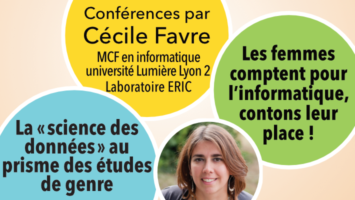
À l’occasion de la journée internationale des femmes en sciences, qui a lieu cette année le dimanche 11 février, le comité égalité-diversité du LIA organise une journée de conférences le vendredi 16 février 2024. Ces conférences seront menées par Cécile Favre, de l’université Lyon 2. Conférence 1: (de 10h à 11h30) Lieu : Amphi Ada Lovelace Titre : La « science des données » au prisme des études de genre : objet de recherche et source de questionnements méthodologiques pour la scientométrie. Le cas du défi EGC 2020. Résumé : Cette communication s’appuie sur le défi lancé par l’association EGC (Extraction et Gestion des Connaissances) qui rassemble des chercheuses et des chercheurs travaillant au croisement de l’informatique et des statistiques, en « science des données ». Pour la 20ème édition de sa conférence annuelle, l’association a mis à disposition des matériaux la concernant en vue de leur analyse. Les matériaux empiriques proposés sont notamment les actes publiés, l’ensemble des emails envoyés sur sa liste de diffusion. Nous avons complété ces matériaux avec des éléments récoltés sur le site Web concernant l’organisation des 19 éditions de la conférence tels que les conférences invitées, les comités de lecture, les comités d’organisation, etc. Plus d'infos

1 … 4 5 6 7 8 9